
If you’re under 25 and you’ve recently looked at your car insurance bill, you already know what this article is about.
The numbers are painful. A 19-year-old in most states pays two to three times more for car insurance than a 35-year-old with the exact same car and the exact same driving record. A 22-year-old with zero accidents and zero tickets still gets quoted rates that feel completely disconnected from reality. And the frustrating part is that nobody explains why — they just hand you the bill and expect you to pay it.
Here’s why it happens. Insurance companies price risk statistically, and the statistics on young drivers are genuinely challenging. Drivers under 25 are involved in a disproportionate number of accidents compared to older drivers, not because they’re bad people but because driving judgment and hazard awareness genuinely improve with years of experience behind the wheel. Insurers know this, and they price for it across the entire age group — including the careful, responsible young drivers who would never deserve those rates individually.
That’s the bad news. The good news is that there is significantly more you can do about it than most people realize. Young drivers who take the right steps consistently pay hundreds — sometimes over a thousand dollars — less per year than their peers who don’t bother.
This guide explains exactly what those steps are.
Shop Around — Rates Vary Wildly Between Insurers
This point sounds obvious, but the majority of young drivers take the first quote they receive or simply stay on their parents’ policy without ever comparing alternatives. That’s an expensive habit.
Different insurance companies use different formulas to assess risk, and those differences are enormous when it comes to young drivers specifically. Company A might see a 21-year-old male as an extremely high-risk customer and price accordingly. Company B might weight other factors — driving record, vehicle type, academic performance — more heavily and offer a significantly lower rate for the exact same person.
The only way to find out which company views you favorably is to get multiple quotes. Use comparison websites like The Zebra, NerdWallet, or Insurify to get several quotes simultaneously. Then go directly to a few company websites — GEICO, State Farm, Erie, and USAA if you qualify — because some companies don’t always show their best rates through third-party aggregators.
Do this every single year before your policy renews. The company that offered the best rate when you were 19 might not be the best option at 21. Your risk profile changes as you accumulate a clean driving record, and different insurers reward that progression differently.
Young drivers who shop around consistently at renewal report saving an average of $400 to $800 per year compared to those who never switch.
Stay on Your Parents’ Policy as Long as Possible
If you’re under 25, still live at home at least part of the time, and your parents are willing, staying on their insurance policy is almost always the cheapest option available to you.
Adding a young driver to an existing family policy costs significantly less than that young driver purchasing a standalone policy. The older drivers on the policy bring down the overall risk profile, and insurers typically offer multi-car and multi-driver discounts that reduce the per-person cost further.
The savings can be substantial. A 20-year-old buying their own policy might pay $2,400 a year. Being added to their parents’ policy for the same vehicle might cost an additional $900 to $1,200 on the family bill. That’s a real and significant difference.
The arrangement obviously requires a cooperative family situation and works best when you’re still using the same home address at least part of the time. Be honest with your insurer about your living situation — misrepresenting where a vehicle is garaged to get cheaper rates is insurance fraud and creates serious problems if you ever need to file a claim.

Take a Defensive Driving Course
This is one of the most underused discounts available to young drivers, and it genuinely works.
Most major insurance companies offer a discount of 5% to 15% on premiums for drivers who complete an approved defensive driving course. These courses are available online in most states, typically cost between $25 and $75, and take anywhere from four to eight hours to complete. The math is straightforward — if a $50 course saves you 10% on a $2,000 annual premium, you’ve saved $200 with a one-time investment.
Beyond the discount, the courses actually do make you a better driver. They cover hazard recognition, following distance, adverse weather driving, and emergency response techniques — all things that genuinely reduce your likelihood of being in an accident, which over time improves your driving record and brings your rates down further.
Call your insurer before you sign up and confirm which courses they accept for the discount. Not every course qualifies with every company, and you want to make sure you’re doing one that will actually reduce your premium.
Maintain a Clean Driving Record — It Pays More Than You Think
Every ticket, every at-fault accident, and every insurance claim you file in your early driving years follows you for three to five years in most states and has a direct and significant impact on what you pay.
A single speeding ticket can raise a young driver’s premium by 20% to 30%. An at-fault accident can raise it by 40% to 50% or more. For someone already paying high rates because of their age, those increases are genuinely brutal.
The reverse is also true. Every year you drive without an incident improves your standing with insurers. Most companies reward three consecutive clean years with a safe driver discount. Five clean years, and your rate in several categories starts to approach what older experienced drivers pay.
This sounds simple, but it means being genuinely thoughtful about how you drive rather than just how you drive when you think you might get caught. Avoiding speeding, staying off your phone behind the wheel, not driving when you’re tired, and being cautious in parking lots and low-speed situations where fender benders happen most often — all of this compounds into a cleaner record that directly saves you money.
Choose the Right Car to Insure
If you haven’t bought your first car yet — or you’re thinking about upgrading — the choice of vehicle has a larger impact on your insurance premium than most young drivers realize.
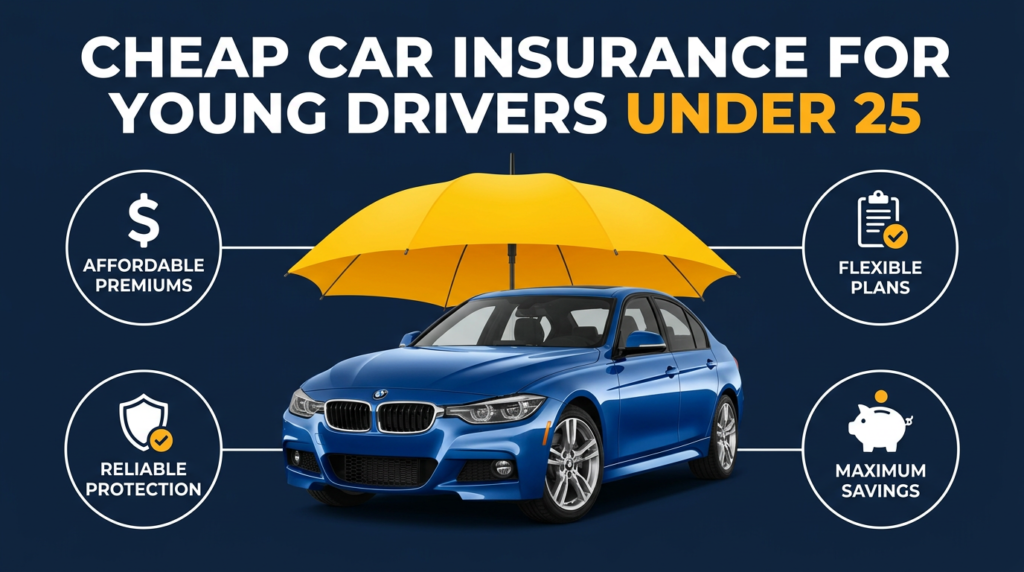
Sports cars, high-performance vehicles, and luxury cars cost significantly more to insure regardless of who’s driving them. For a young driver, putting one of these vehicles on your record amplifies the age surcharge significantly. A 21-year-old driving a BMW M3 will pay rates that are almost unbelievably high in some states.
The vehicles that are cheapest to insure for young drivers share a few common characteristics. They have strong safety ratings from organizations like the IIHS and NHTSA. They have moderate repair costs — meaning parts are available and mechanics can work on them without specialized equipment. They have low theft rates. And they have engines modest enough that insurers don’t classify them as performance vehicles.
Midsize sedans, compact crossovers, and family hatchbacks consistently land at the lower end of insurance pricing for young drivers. Specific models like the Honda Civic, Toyota Corolla, Mazda3, and Subaru Impreza come up repeatedly in recommendations for affordable young driver insurance because they tick all of these boxes.
Before you fall in love with a car, spend five minutes getting an insurance quote for it. That five minutes might save you thousands per year.
Consider Usage-Based Insurance Programs
If you’re a careful driver who doesn’t drive particularly often, usage-based insurance is worth taking seriously.
These programs — offered by companies like Progressive through their Snapshot program, Allstate through Drivewise, and State Farm through Drive Safe and Save — track your driving through an app or a small device installed in your car. They monitor things like how hard you brake, how fast you accelerate, what time of day you drive, and how many miles you put on the car.
For young drivers who are genuinely careful behind the wheel, these programs can deliver savings that traditional discounts can’t match. Some drivers report reductions of 20% to 40% on their premiums after enrolling and demonstrating consistent safe driving habits over the monitoring period.
The obvious tradeoff is privacy — you’re sharing detailed driving data with your insurer. Whether that tradeoff is acceptable is a personal decision. But for young drivers who know they drive carefully and are looking for a way to prove that to their insurer, telematics programs offer exactly that opportunity.
The one thing to be aware of: some programs can also raise your rates if the data shows driving behavior the insurer considers risky — late night driving, frequent hard braking, or high mileage. Make sure you understand how the program works before you enroll.
Apply for Every Discount You Qualify For
Beyond defensive driving and safe driver discounts, there are several others specifically relevant to young drivers that are worth asking about by name.
The good student discount is one of the most valuable available to drivers under 25 who are still in school. Most insurers offer it to full-time students maintaining a B average or better, and the discount typically ranges from 8% to 25%. If you’re in high school or college and pulling decent grades, this discount alone can make a meaningful difference.
The away-at-school discount applies to college students who attend school more than a certain distance from home — usually 100 miles — and leave the family car behind. If you’re not driving the car on a daily basis because you’re living in a dorm or apartment in another city, many insurers will reduce the rate significantly because the vehicle is being driven much less than when you’re home.
The paperless billing and autopay discount is small but requires zero effort. Set up automatic payments and paperless statements and most companies automatically knock a few dollars off your monthly premium.

The Honest Bottom Line
There is no magic fix that instantly makes car insurance cheap for young drivers. The age surcharge is real, it’s based on real statistical data, and it takes time to age out of it. Every year you get older, every year you drive without an incident, and every year you consistently apply these strategies, your rates come down.
What these strategies do is accelerate that process and minimize the damage in the meantime. Young drivers who shop around, maintain clean records, choose sensible vehicles, take advantage of every discount, and stay on family policies where possible consistently pay several hundred dollars less per year than those who don’t.
That difference adds up. Over four or five years — the period between 18 and 23 when rates are highest — smart choices about car insurance can save you $3,000 to $5,000 compared to just accepting whatever number lands in your inbox.
That’s money worth fighting for.
read more article….
How to Get Cheap Car Insurance in 2026
Best Personal Loans with Low Interest Rates in 2026
Disclaimer: Insurance rates vary by state, driving history, vehicle, and insurer. Always get multiple quotes and verify current rates directly with insurance providers before making decisions.
About the Author